Loading...
A structure that leans, sinks, or cracks at the base started with a footing that was not built for local soil. Brownsville's expansive clay moves with every rain cycle - footings designed for it stay put.
Concrete footings in Brownsville are the underground anchors that keep structures from sinking, tilting, or cracking as the soil moves - most footing projects take one to three days on site, but the full timeline including the City of Brownsville permit and post-pour curing runs two to four weeks.
Most structural problems that show up years after a project is finished - cracks in walls, doors that will not close, floors that have started to slope - trace back to a footing that was too shallow, too narrow, or poured into soil that was never properly prepared. In Brownsville, that problem is amplified because the clay soil here expands and contracts with every wet and dry season. A footing designed for local conditions holds steady through that cycle. One that ignores it does not.
For additions and new structures, footings are only the first step - the work above them connects naturally to foundation installation so the entire base system is built as a single coordinated project.
If a deck, porch, or outbuilding has started to lean noticeably or one corner has dropped lower than the others, the footing underneath has likely failed or shifted. In Brownsville, this often happens after a period of heavy rain followed by a dry stretch - the clay soil swells and shrinks, and a footing that was not deep or wide enough gets pushed out of position.
Diagonal cracks from the corners of door frames or windows, and horizontal cracks along a wall near the base, can signal that the footings beneath are moving unevenly. This is a common early warning sign in South Texas homes built on expansive clay. Catching it early means less damage to the structure above.
When footings shift, the structure above shifts with them - and one of the first things homeowners notice is that doors or windows that used to work fine now stick, drag, or will not latch. If this is happening in multiple spots around your home or outbuilding, the base of the structure may be moving.
If you are adding a room addition, a carport, a covered patio, or replacing a shed that was built without proper footings, now is the right time to do them correctly. Many older structures in Brownsville were built with posts simply set in dirt or shallow concrete that has since cracked - rebuilding on proper footings is what makes the new structure last.
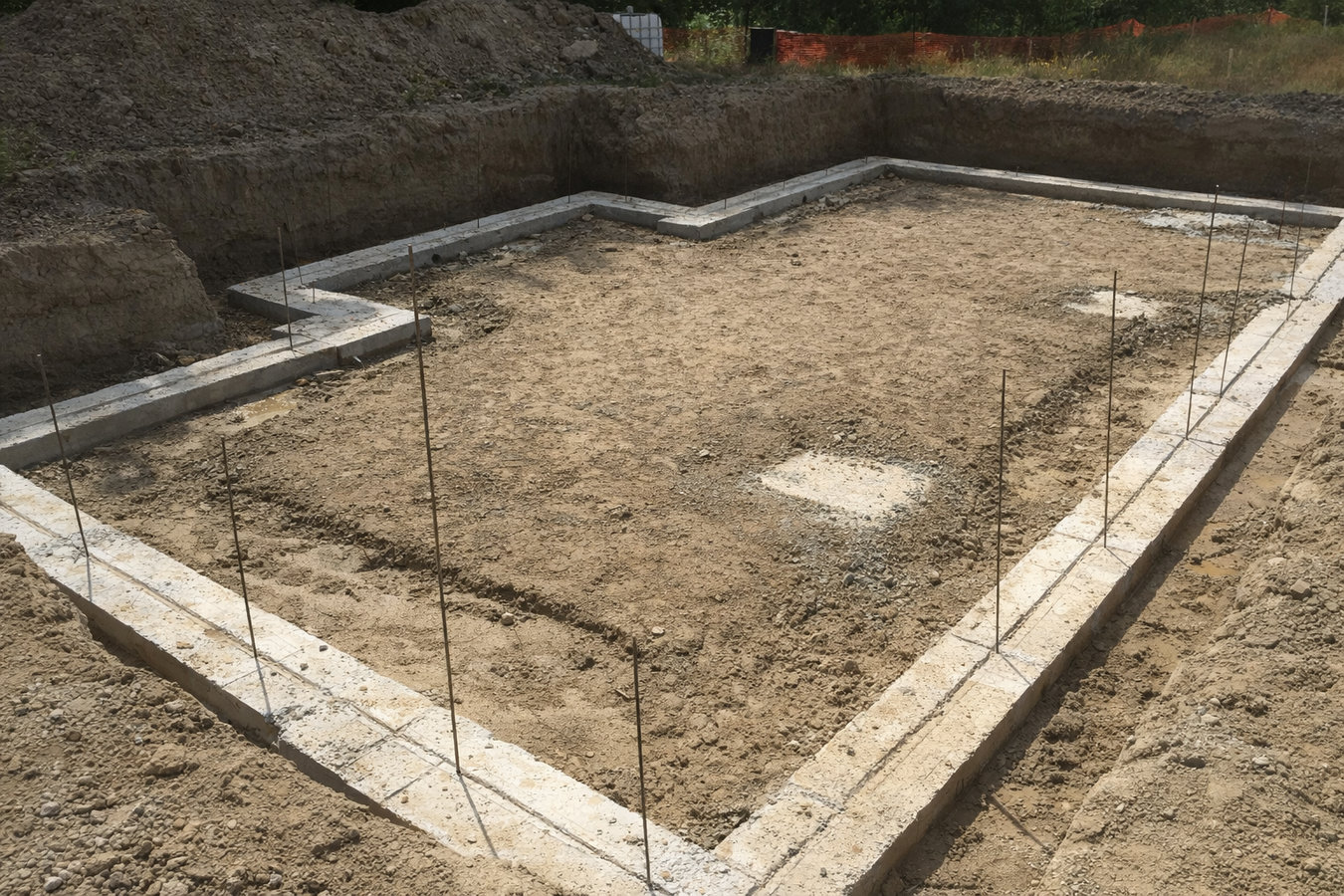
The type of footing your project needs depends on what you are building and how the load is distributed. Strip footings run continuously under a wall or the perimeter of an addition, spreading the load evenly along the full length. Pier footings are individual columns dug to stable soil depth - common for decks, carports, and covered patios where you need discrete anchor points rather than a continuous base. For any structure that will be covered by windstorm insurance in Cameron County, the footing and the hardware connecting it to the structure above must meet specific wind load requirements.
Every footing we pour includes steel reinforcing bars placed correctly inside the form - elevated off the soil floor, not resting on dirt. The steel is what gives the footing its tensile strength and keeps it from cracking when the ground shifts. For projects that involve a full slab above the footings, the process connects directly to foundation raising when an existing foundation needs correction before new construction begins on top of it.
Suits homeowners adding room additions or wall extensions that need a continuous concrete base running under a wall line.
Suits decks, carports, and covered patios that need individual column anchors dug to stable soil depth below the clay layer.
Suits slab-on-grade construction where a reinforced beam ties the slab edge to stable subsoil for uniform load distribution.
Suits any structure in Cameron County that must qualify for Texas Windstorm Insurance Association coverage, with anchor bolting designed to the required wind load specifications.
Brownsville's soil is classified as Vertisol clay - one of the most expansive soil types found anywhere in the country. Parts of Cameron County have a relatively high water table as well, which means a hole dug in the morning can have standing water in it by afternoon during the rainy season. Add to that summer temperatures that regularly exceed 95 degrees, and you have a combination that pushes fresh concrete toward failure if the contractor does not plan for it. We schedule pours for early morning during summer months and use curing protection to slow surface drying so the concrete reaches full strength rather than skinning over too fast.
We work throughout the Brownsville service area, including projects in San Benito and Los Fresnos where the same clay soil and coastal wind load requirements apply. Whether you are anchoring a small backyard structure or setting the footings for a permitted addition, the permit process, inspection requirements, and soil conditions are the same across the Lower Rio Grande Valley.
We ask what you are building, where on the property, and whether you have spoken with the city about permits. You will have a rough ballpark before we visit - we reply within one business day.
We walk the area, take measurements, and assess soil and drainage conditions. In Brownsville, this step matters because clay depth and drainage patterns vary across the city. You receive a written quote within a day or two that includes the permit fee.
We apply for the City of Brownsville building permit and call 811 to have underground utility lines marked before any digging begins. The city inspector must view the footing before the pour - we schedule that inspection so it does not delay your project.
The crew excavates to the specified depth, sets forms, places steel reinforcing bars elevated off the soil, and pours after the city inspection approves. The concrete needs at least seven days before any load is placed on it - we give you the exact timeline in writing.
We visit the site, assess the soil conditions, and give you a quote that includes the permit fee - no guessing, no hidden line items added later.
(956) 505-5077We apply for the City of Brownsville building permit and call for the inspector to approve the footing before the concrete is poured. That inspection is your independent confirmation that the depth, size, and steel placement are correct - before it is all buried. No permit, no inspection, no protection.
Cameron County clay soil is expansive - it swells with rain and shrinks in dry spells. We design footing depth and width for local soil behavior, not just the minimum standard. Texas A&M AgriLife Extension documents how South Texas Vertisol clay affects foundation performance, and we account for it in every footing we pour.
Brownsville is in a coastal wind zone. Structures that need to qualify for Texas Windstorm Insurance Association coverage must be anchored to the footing in a specific way - from the bolt pattern to the connection hardware. We know those requirements for Cameron County and build them in from the start so you do not have to redo work later.
Texas law requires contractors to call 811 before digging so underground utility lines are marked. We do it on every single job - not just the ones where we think lines might be nearby. It is a basic safety step that protects your property, your neighbors, and our crew.
These are not separate selling points - they are connected. A city inspection requires a permit, a permit means the footing depth is on record, and footing depth designed for local clay is what keeps your structure level when the soil moves. The American Concrete Institute sets the national standards for steel placement, curing, and mix design that govern how our crews work on every project in Brownsville and the surrounding area.
When an existing foundation has settled or shifted, raising and re-leveling it restores the structure above without a full tear-out.
Learn MoreNew construction and additions need a full foundation system - footings are the first step in that process.
Learn MoreBrownsville's busy season books quickly - reach out now and we will get your permit started so there are no delays when you are ready to build.